

Search is no longer what it was twelve months ago.
In 2026, AI systems are answering questions before anyone clicks a link. Google AI Overviews, ChatGPT, Perplexity, and Gemini are pulling from trusted sources, generating complete answers, and reshaping how people discover brands online.
For businesses still relying on traditional keyword-driven SEO, the traffic numbers tell a hard truth. Organic CTR drops 61 percent when an AI Overview appears on a query, according to research from Seer Interactive. Zero-click searches now account for over 60 percent of all queries globally, climbing to 77 percent on mobile. And the overlap between top-10 Google rankings and AI Overview citations has collapsed from 75 percent in mid-2025 to between 17 and 38 percent by early 2026.
The brands that adapt will gain a competitive edge that compounds over time. The ones that wait will watch their visibility erode across every search surface.
Here are the seven AI SEO trends defining 2026, and what your brand needs to do about each one.
1. Generative Engine Optimization Is No Longer Optional
Generative Engine Optimization, or GEO, has moved from an emerging concept to a core marketing discipline. According to industry data, 65 percent of marketers are now optimizing for AI chat interfaces, and 47 percent of brands still lack a GEO strategy, leaving a significant competitive gap.
Unlike traditional SEO, which focuses on ranking in a list of links, GEO focuses on being cited and synthesized by AI systems when they generate responses. The goal is not just to appear in search results. It is to become the source that AI platforms reference when answering a question.
Research from Princeton shows that the top GEO optimization methods can improve AI visibility by 30 to 40 percent. The strategies that work best include citing sources within your content (40 percent improvement), adding specific statistics and data points (37 percent improvement), and including expert quotations (30 percent improvement).
The new metric to track is Share of Model, which measures how frequently your brand appears in AI responses compared to competitors. Think of it as share of voice for the AI era. Industry benchmarks suggest that consistent GEO effort over 3 to 6 months can produce a 30 to 40 percent improvement in Share of Model for target queries.
Each AI platform has different citation behaviors. Perplexity has the highest citation rate at 13 percent and always provides source attribution, making it the most accessible entry point for GEO. ChatGPT holds roughly 64 percent market share among AI platforms, so visibility there reaches the largest audience. Google AI Overviews matter most for enterprise B2B because they are integrated into existing search behavior. A complete GEO strategy addresses all three.
What to do now: Audit your top-performing content. Ask ChatGPT, Perplexity, and Google AI Overviews questions that your buyers would ask. Record whether your brand appears, how it is described, and who gets cited instead. That is your GEO baseline. Build from there.
2. Zero-Click Search Has Become the Default
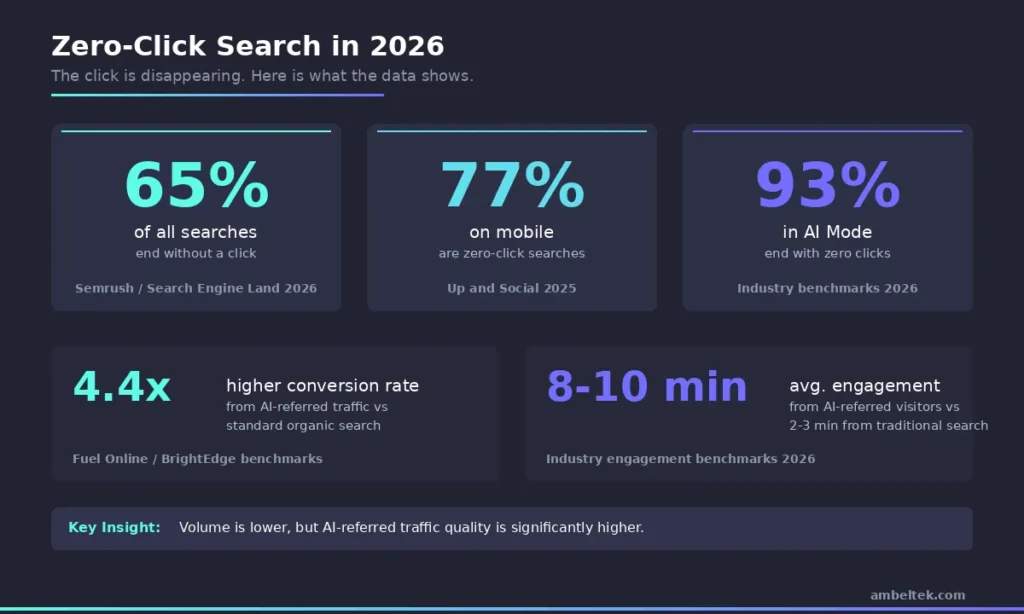
The click is disappearing. In 2026, more than 65 percent of Google searches end without a click, according to aggregated forecasts from Semrush and Search Engine Land. On mobile, that number reaches 77 percent. For queries that trigger AI Overviews, the zero-click rate hits 83 percent.
Google AI Mode pushes that even further. In AI Mode, the zero-click rate reaches 93 percent.
This does not mean search traffic is dead. It means the nature of that traffic has changed. AI-referred visitors convert 4.4 times better than standard organic search visitors because they arrive already informed and further along in their buying decision. Average on-site engagement from AI-referred traffic runs 8 to 10 minutes, compared to 2 to 3 minutes from traditional Google clicks.
The volume is lower, but the quality is significantly higher.
This changes how marketing leaders should think about pipeline. A smaller number of AI-referred visitors can generate comparable or greater pipeline contribution than a much larger volume of traditional top-of-funnel organic traffic. The informational content that used to fill your top of funnel, the what-is-X and how-to-do-Y articles, is now answered directly on the search results page before anyone reaches your site. The funnel has not disappeared. It has moved upstream into AI conversations.
What to do now: Stop measuring success purely by traffic volume. Track AI citation frequency, Share of Model (how often your brand appears in AI responses compared to competitors), and conversion rates from AI-referred traffic. These are the metrics that matter in a zero-click world.
3. Entity SEO and Knowledge Graphs Are the Foundation
Search engines no longer match keywords to pages. They match entities to relationships.
Google’s Knowledge Graph now contains over 500 billion facts about 5 billion entities. When someone searches, Google identifies the entities in the query and returns results based on entity authority and relevance. A well-established business entity can rank for hundreds of related queries automatically, without creating separate pages for each keyword.
In June 2025, Google contracted its Knowledge Graph by 6.26 percent, removing over 3 billion entities in a single week. This cleanup signaled a focus on high-quality, well-defined entities rather than loosely structured data. Businesses with weak entity presence face near-invisibility regardless of keyword optimization.
Entity authority also drives AI visibility. As Jason Barnard explained in his 2026 discussion on brand entity SEO, all AI systems use what he calls the algorithmic trinity: search engines, LLM chatbots, and the knowledge graph. The knowledge graph has moved from a niche SEO topic to the central pillar of modern optimization.
What to do now: Build a complete entity infrastructure for your brand. Implement Organization and Person schema with SameAs identifiers. Establish consistent NAP (name, address, phone) across all platforms. Create a Google Entity Stack across Google properties. Verify your Knowledge Graph presence using the Google Knowledge Graph API and Wikidata.
4. Structured Data Is Now an AI Trust Signal
Schema markup has evolved from a nice-to-have SEO enhancement to a critical factor in AI visibility.
Google’s March 2026 core update changed how structured data influences search. AI Mode now uses schema for entity resolution and claim verification during answer synthesis. Content with proper schema markup has a 2.5 times higher chance of appearing in AI-generated answers, according to implementation data from Stackmatix.
The shift is significant. Schema is no longer primarily about triggering rich results in traditional SERPs. It is about telling AI systems what your content is, who created it, and how trustworthy the publisher is. Sites with clean, accurate entity schema saw measurably improved citation rates in Google AI Mode answers following the March 2026 update.
The highest-leverage schema types in 2026 are Organization, Person, FAQPage, HowTo, Article, and Speakable. JSON-LD delivered in the document head remains the recommended format.
What to do now: Implement JSON-LD schema on every key page. Prioritize Organization schema with SameAs identifiers, Article schema with author credentials, and FAQPage schema for question-and-answer content. Use the knowsAbout property to declare your topical authority areas. Validate everything through Google’s Schema Markup Testing Tool.
5. AI Overviews Are Reshaping Traffic Patterns
Google AI Overviews now appear on roughly 48 percent of tracked queries, up 58 percent year-over-year according to BrightEdge data from February 2026. They appear in over 200 countries and 40 languages.
The data on who gets cited is worth understanding. SERP position one carries a 33 percent AI citation probability, while position 10 drops to 13 percent, a 60 percent decline. But ranking high no longer guarantees citation. The overlap between traditional rankings and AI citations has collapsed, meaning brands need a separate strategy for AI visibility.
Interestingly, 63 percent of businesses report that AI Overviews have had a positive effect on their organic traffic and visibility. The businesses benefiting are the ones that restructured their content for AI synthesis: clear answers, structured data, authoritative sourcing, and topical depth.
Over 68 percent of terms that trigger AI Overviews get 100 or fewer monthly searches. Almost 80 percent fall into low keyword difficulty ranges. This means niche, long-tail content faces the highest AI disruption risk, but also the biggest opportunity for brands that optimize correctly.
On the platform side, AI Overviews now appear most heavily on informational queries. Around 88 percent of keywords triggering AI Overviews are informational in nature, and 81 percent of those queries also include a People Also Ask section. Roughly 81 percent of searches triggering an AI Overview happen on mobile. Understanding this distribution helps you prioritize which content to optimize first.
What to do now: Identify which of your target queries trigger AI Overviews. Structure content with direct answers at the top of each section (the BLUF method, bottom line up front). Use comparison tables, bullet points, and cited statistics. These formats are what AI systems extract and synthesize most reliably.
6. Search Everywhere Optimization Is the New Reality
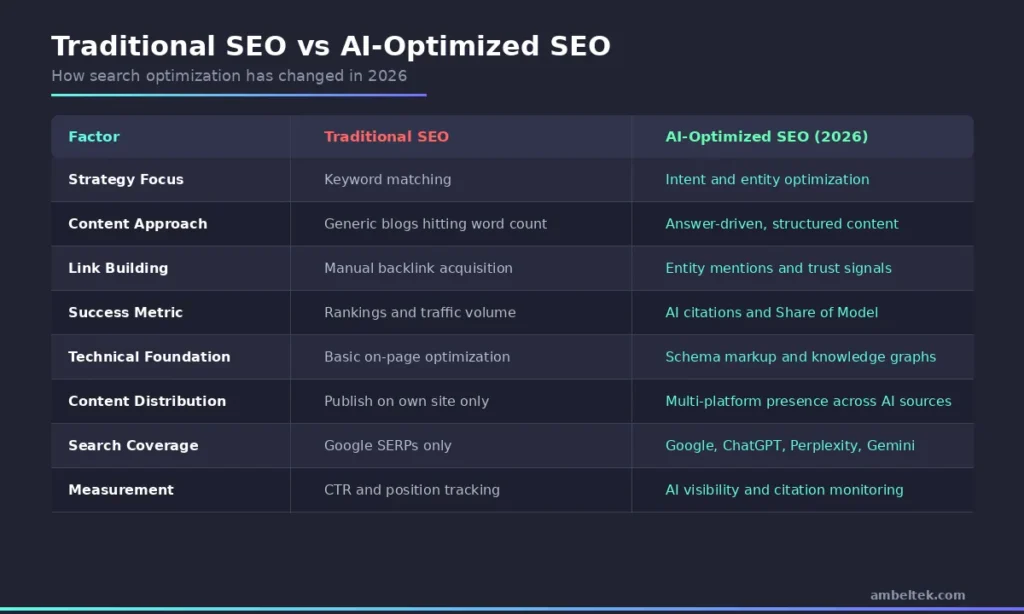
Search in 2026 extends far beyond Google. ChatGPT Search processes 250 to 500 million weekly queries. Perplexity handles around 50 million weekly queries with 780 million monthly queries overall. YouTube remains the second-largest search engine globally. Reddit accounts for 46 percent of AI citations according to some analyses.
AI platforms are capturing 15 to 20 percent of informational query volume. Google still holds roughly 80 percent of overall search, but for research, learning, and commercial investigation queries, the share shift is structural and growing.
The brands building visibility in 2026 are the ones showing up across every platform that AI systems draw from. A study from Stacker in late 2025 found that distributing content across trusted third-party publications can increase AI citations by up to 325 percent compared to publishing only on your own site.
Only 30 percent of brands that appear in an AI-generated answer show up again in the next response to the same query, according to the 2026 State of AI Search report from AirOps. Run that same query five times, and just 20 percent of brands persist. Consistency across multiple sources is what builds persistence.
What to do now: Expand your content distribution beyond your website. Publish on LinkedIn, Reddit, Medium, YouTube, and industry publications. Pursue digital PR that earns mentions on sites AI systems trust and cite. Build a consistent brand descriptor that appears the same way across every platform.
7. Google’s March 2026 Core Update Raised the Bar
Google’s March 2026 core update finished rolling out in mid-April and reinforced a clear direction. The update re-weighted three quality signals: information originality, author expertise, and topical coherence.
Information originality means content that adds something genuinely new. Not rewritten versions of the top five competing pages, but original research, proprietary data, first-hand case studies, and analysis that requires access or expertise the reader cannot find elsewhere. Google calls this Information Gain, measuring how much new knowledge a piece of content contributes relative to what already ranks.
Author expertise means verifiable credentials. The March 2026 update does not penalize AI-assisted content categorically. Content that is assisted by AI and substantially edited by a named human expert, grounded in original perspective and attributed with verifiable credentials, performs well. What struggles is generic, mass-produced content without identifiable authorship.
Topical coherence means consistent authority within a defined subject area. Sites that publish opportunistically across many topics at shallow depth are losing ground to sites with deep, focused coverage of their core expertise.
What to do now: Audit your content for Information Gain. If your article disappeared tomorrow, would anyone lose access to information they could not find elsewhere? If the answer is no, the content needs original data, unique analysis, or first-hand expertise. Build author profiles with Person schema and visible credentials on every piece of content.
The Bottom Line for Brands
The shift from traditional SEO to AI-optimized visibility is not coming. It is here.
Organic CTR is declining. Zero-click searches are the default. Rankings alone no longer guarantee visibility. AI systems are selecting their own trusted sources, and the criteria they use favor structured data, entity authority, original expertise, and multi-platform brand presence.
The brands winning right now are not the ones with the highest domain authority or the most backlinks. They are the ones that understood the shift early and rebuilt their content strategy around how AI systems discover, evaluate, and cite information.
Every week you wait is a week your competitors have to build entity authority, earn AI citations, and establish the kind of brand presence that becomes self-reinforcing across every AI platform.
The playbook is clear. The question is whether you execute it now or play catch-up later.
At Ambeltek, we help brands build AI-first visibility strategies that work across Google AI Overviews, ChatGPT, Perplexity, and every platform where your buyers are searching. From entity optimization and schema implementation to full GEO audits and content restructuring, we bridge the gap between traditional SEO and the AI search landscape.
If your organic traffic is declining despite stable rankings, or if your brand is invisible when AI systems answer questions in your industry, that is the gap we close.