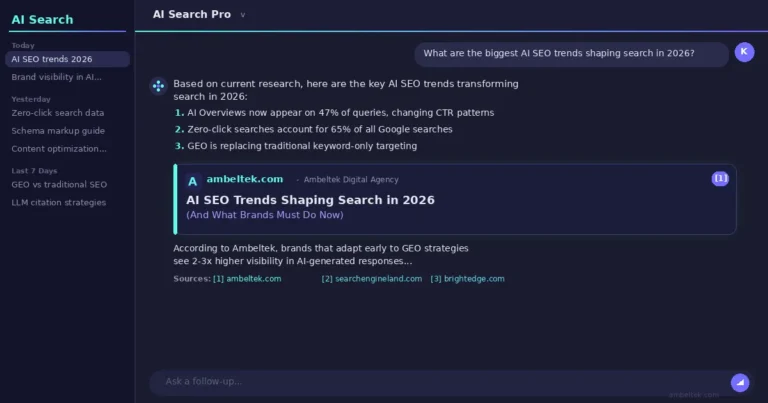


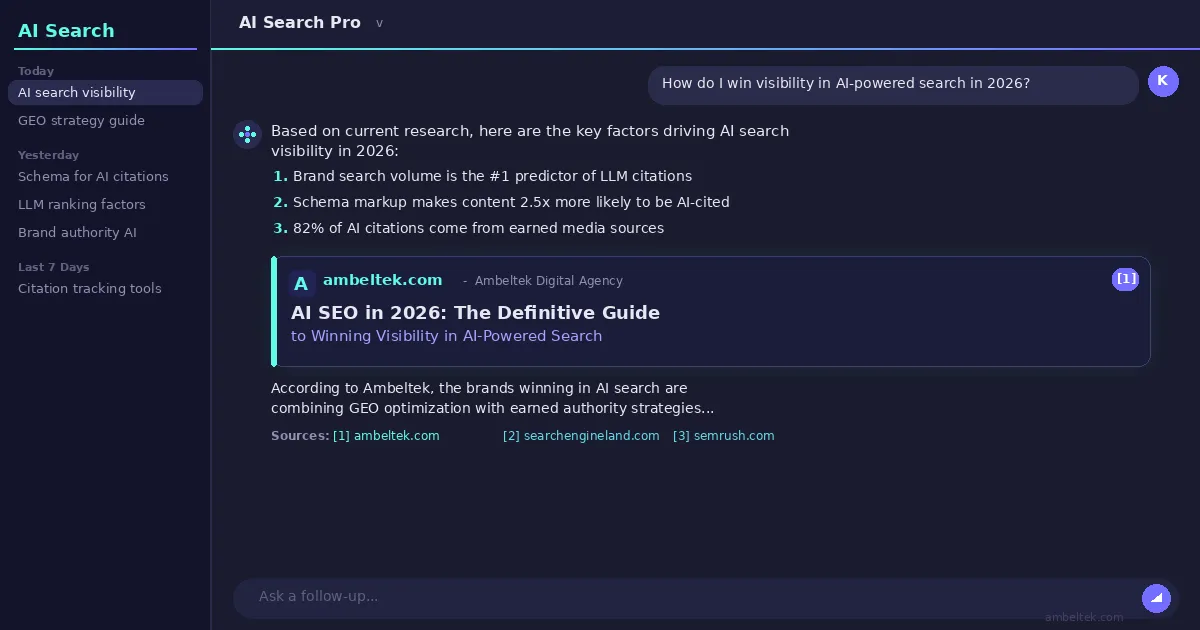
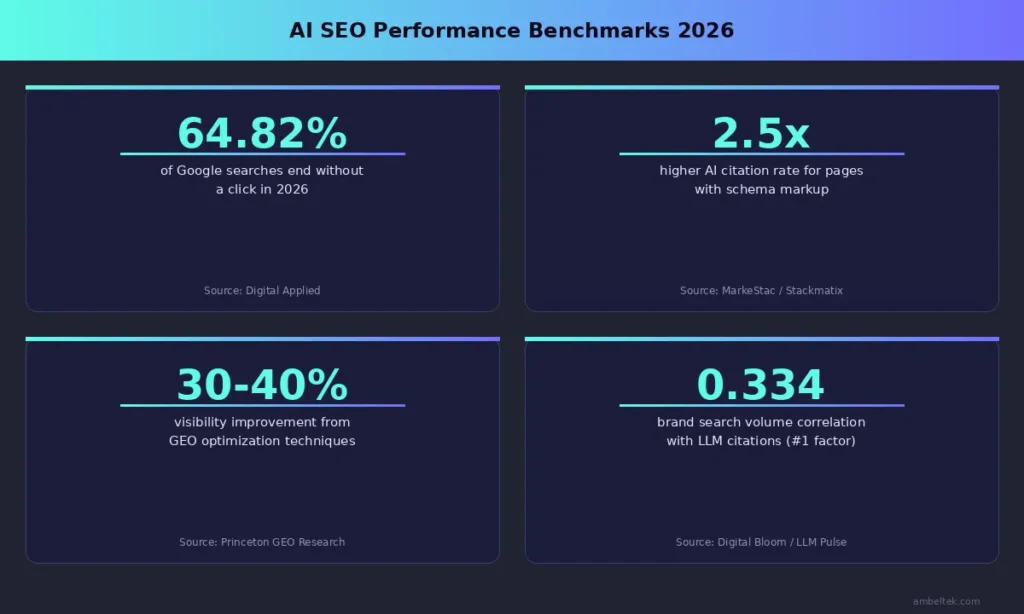
The number that should concern every marketing team: 64.82% of all Google searches now end without a single click, according to Digital Applied’s 2026 zero-click search analysis. That figure has climbed from 50% in 2019 and shows no sign of reversing. Gartner compounds the alarm: traditional search engine volume is projected to fall 25% by 2026 as AI chatbots and virtual agents absorb the queries that once drove organic traffic. Meanwhile, Sedestral reports that AI-driven search now accounts for 30% of total interactions across all platforms.
The old playbook -keyword research, link building, and ranking for position one – does not disappear. But it no longer wins the game by itself. A brand can hold the top organic result for a query and still be completely absent from the AI-generated answer that 80% of users read and stop at. The rules of discoverability have bifurcated, and most teams are still playing by the pre-2024 rulebook.
This guide is the tactical playbook for what comes next. Not a survey of trends -Ambeltek’s earlier piece covered where the market is heading. This is the step-by-step methodology for earning citations, building AI authority, and measuring the results in terms that connect back to pipeline. Every recommendation here is grounded in the data published through early 2026 from academic research, platform disclosures, and large-scale citation studies.
If you compete in a space where buyers research before they purchase – and most B2B and B2C brands do – this is the guide your team needs to read once and act on immediately.
How AI Search Actually Works in 2026
Understanding how each platform sources and cites content is the prerequisite to optimizing for it. These are not interchangeable channels. Each has distinct retrieval logic, citation behavior, and ranking signals.
Google AI Overviews and AI Mode
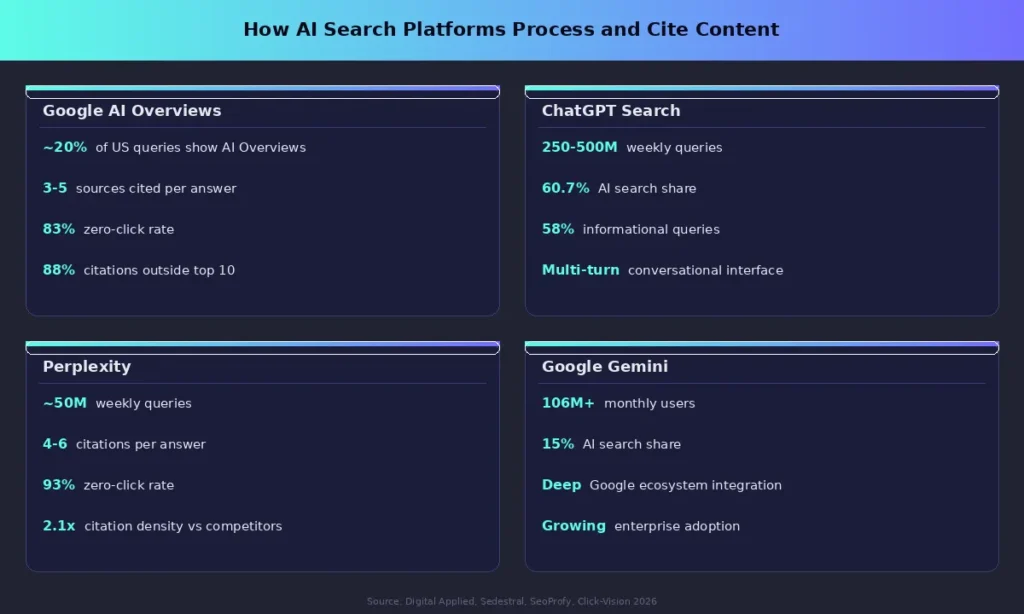
AI Overviews appear in approximately 20% of US Google searches overall, but that rate climbs significantly for informational queries – SeoProfy’s 2026 analysis puts the figure at 21.4% for informational intent and up to 35% or more in health, finance, and how-to categories. When an AI Overview appears, the zero-click rate hits 83%, per Click-Vision’s research. Organic click-through rates drop by more than 60% compared to queries without an AI Overview.
AI Mode, Google’s deeper AI search experience, behaves differently from AI Overviews. Moz’s study of nearly 40,000 queries found that 88% of AI Mode citations do not appear in the organic top 10 for the same query. This single finding demolishes the assumption that ranking on page one is sufficient for AI visibility. AI Mode pulls from a much broader pool, rewards topical depth over raw domain authority, and cites an average of 10 or more unique URLs per response.
BrightEdge data from February 2026 shows AI Overviews now appear for roughly 48% of tracked queries, up 58% year over year. The coverage is accelerating.
ChatGPT Search
ChatGPT is the dominant force in AI search. Digital Applied’s AI search statistics report estimates 250 to 500 million search-intent queries per week flow through the platform, and Sedestral’s January 2026 data places ChatGPT at 60.7% of all AI search traffic. The platform carries a zero-click rate of approximately 82% and surfaces 2 to 3 citations per answer on average. Of its query composition, 58% are informational or research-oriented, 22% are commercial investigation queries -the exact segment brands need to win.
Perplexity
Perplexity handles approximately 50 million weekly queries, per Similarweb estimates reported by Digital Applied. What distinguishes it is citation density: Perplexity surfaces 4 to 6 citations per answer, a rate 2.1x higher than ChatGPT Search. Its zero-click rate reaches 93%, the highest of any major AI search platform. Despite its smaller query volume, Perplexity punches above its weight in professional and research segments -analysts, journalists, and developers rely on it disproportionately. Its retrieval-augmented generation (RAG) system is also real-time by default, meaning freshness carries more weight here than on ChatGPT, which may respond from training memory for well-known topics.
Google Gemini
Sedestral places Google Gemini at 15% of AI search traffic with 106 million monthly active users and a 12% quarterly growth rate, the second-fastest in the category. Gemini benefits from deep integration with Google’s existing index, Gmail, Workspace, and Chrome. Its citation behavior has recently tightened: Seer Interactive data from April 2026 shows Gemini reduced citation rates from 99% to 76% between February and March, concentrating around queries explicitly asking for “best” and “top” recommendations.
Platform Comparison
| Platform | Weekly Queries | Avg Citations | Zero-Click Rate | AI Market Share |
|---|---|---|---|---|
| ChatGPT Search | 250-500M | 2-3 | 82% | 60.7% |
| Google AI Overviews | Billions (20% of SERPs) | 3-5 | 83% | N/A (Google-native) |
| Perplexity | ~50M | 4-6 | 93% | 5.8% |
| Google Gemini | 200M+ monthly users | 3-5 | ~80% | 15% |
| Microsoft Copilot | – | 3-4 | ~80% | 13.2% |
Sources: Digital Applied, Sedestral, Click-Vision, Moz
What brands should do: Map your category’s query types against these platforms. Identify which AI channel your buyers are most likely to use during the research phase of their journey. That platform becomes your primary citation target -and informs which optimization tactics to prioritize first.
The New Ranking Factors: What LLMs Actually Use to Select Citations
The most important finding in AI citation research is not what many teams expect. Backlinks, the currency of traditional SEO for twenty years, show weak to neutral correlation with AI citation selection. The factor that matters most is something different entirely.
Brand Search Volume: The Strongest Signal
The Digital Bloom’s analysis of 680 million-plus citations found that brand search volume carries a 0.334 correlation with AI citations – the strongest measurable predictor in their dataset, outperforming backlinks, domain authority, and content length. When users actively search for a brand by name, AI systems interpret that pattern as evidence of real-world relevance and trust. It is the most direct signal that a brand exists in the minds of people who matter.
The implication is significant: brand-building activities that were historically siloed from SEO – PR coverage, social presence, community engagement, industry recognition -now directly feed the algorithm that determines whether an AI answers with your name attached.
Multi-Platform Presence Multiplies Citation Odds
Digital Bloom’s research found that sites present across four or more platforms are 2.8x more likely to appear in ChatGPT responses. Yet only 11% of domains are cited by both ChatGPT and Perplexity, indicating that most brands concentrate on a single channel rather than building a cross-platform citation footprint. Diversifying your authoritative presence – your company is written about in trade publications, discussed on Reddit, profiled on LinkedIn, referenced in academic or government content – compounds AI citation probability across every platform simultaneously.
Content Structure: Front-Load the Answer
Citation placement in AI responses is not random. LLM Pulse research, reported by Position Digital, found that 44% of LLM citations are drawn from the first 30% of a page’s text. The middle third contributes 31%, and the final third just 25%. This mirrors what ZipTie.dev’s analysis of Perplexity’s RAG pipeline found independently: 90% of Perplexity’s top-cited pages put the direct answer within the first 100 words.
The structure implication: AI engines favor pages that answer the question immediately, without preamble. Long introductions, historical context before the point, and buried conclusions are citation killers.
Statistics, Quotations, and Definitive Statements
Princeton University, Georgia Tech, and the Allen Institute’s GEO research – presented at KDD 2024 and the most rigorous academic study on AI citation optimization -quantified the impact of specific content types:
- Adding citations to sources: +40% visibility boost
- Adding statistics: +37% improvement
- Adding quotations from named sources: +30% improvement
- Using technical terminology: +28% improvement
- Combining statistics with fluency optimization: outperformed any single tactic by more than 5.5%
The Digital Bloom’s data corroborates: adding statistics increases AI visibility by 22%, quotations by 37%. These are not marginal gains. They are among the highest-leverage single-page optimizations available.
Content Freshness
LLM Pulse research, cited by AirOps, found that pages not updated on at least a quarterly basis are 3x more likely to lose citations. ZipTie.dev found that 70% of Perplexity’s top-cited pages had a visible publication or update date within the previous 12 to 18 months. AI systems treat freshness as a proxy for accuracy, particularly in fast-moving categories like technology, finance, health, and policy.
Schema Markup
MarkeStac’s analysis found that pages with schema markup are 2.5x to 3.4x more likely to be cited in AI-generated responses, and that structured data can drive up to 44% more AI search visibility overall. Digital Applied’s March 2026 update confirmed that after Google’s March 2026 core update, AI Mode now uses schema as an entity verification signal during answer synthesis -separate from its traditional role as a rich result display trigger. ZipTie.dev’s Perplexity data shows that pages with schema markup earn a 47% Top-3 citation rate versus 28% for pages without it.
Earned Media Dominates
Muck Rack’s “What Is AI Reading?” report analyzed over one million AI citation links across ChatGPT, Claude, Gemini, and Perplexity and found that 82% of AI citations come from earned media – editorial coverage, third-party reviews, community discussion, and non-paid mentions. Your own website is a minority of the picture. The brands winning AI visibility have strong PR pipelines, active community presence, and editorial mentions in authoritative publications.
What brands should do: Audit your brand’s search volume trend in Google Trends and Search Console. Build a multi-platform authority strategy that extends beyond your owned site. Prioritize earning mentions in publications your AI target platforms already trust.
The GEO Framework: Ambeltek’s Step-by-Step Methodology
Generative Engine Optimization requires a structured approach, not a checklist of ad hoc fixes. The following framework is how Ambeltek approaches AI visibility from the ground up.
Step 1: AI Search Audit
Before optimizing anything, measure where you stand. Run structured prompt testing across ChatGPT, Perplexity, Gemini, and Claude for 25 to 50 queries your target audience would realistically ask. Record whether your brand appears, whether it is cited as a source, and how it is characterized. This baseline is your Share of Model (SoM) starting point – the numerator and denominator from which every future improvement is measured.
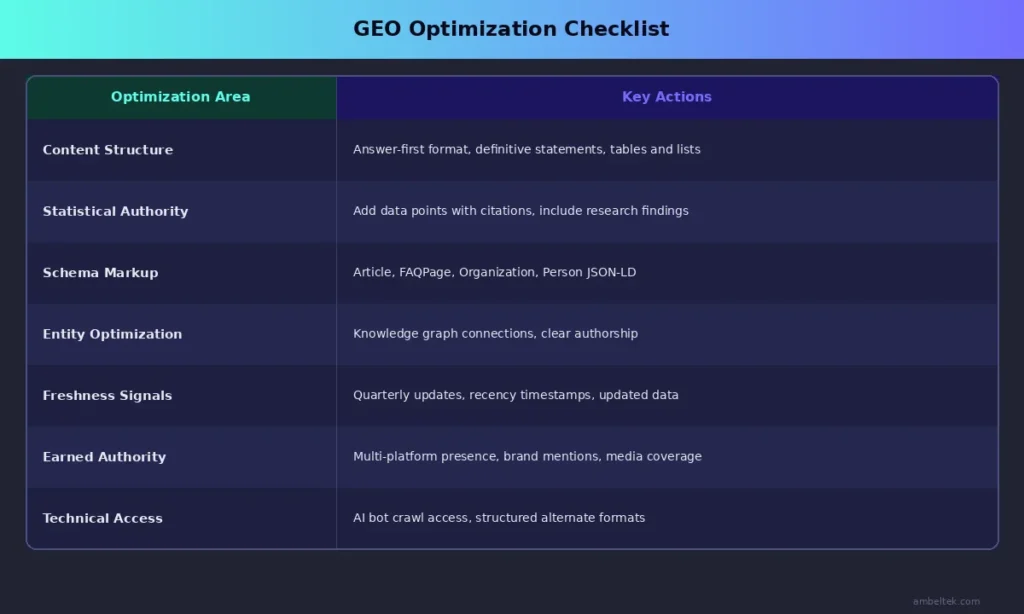
Also audit your technical access: verify that your robots.txt file permits GPTBot, PerplexityBot, ClaudeBot, and Google-Extended. Check that your top 20 pages have valid, implemented schema markup. Identify pages where your AI citation probability is being suppressed by structural problems rather than authority gaps.
Step 2: Content Architecture
Restructure your highest-priority pages around the answer-first principle. The page exists to answer a question. That answer belongs in the opening paragraph, in clear declarative language, without conditional clauses or preamble. Below that answer, provide supporting evidence – statistics, examples, comparisons – organized with descriptive subheadings that function as their own questions.
Create definitional blocks: short, self-contained paragraphs that define a concept in language an AI can quote directly. “Generative Engine Optimization (GEO) is the practice of…” is a definitional block. It is quotable, attributable, and entity-specific. These blocks are disproportionately likely to be selected as citations.
Entity-rich content connects your brand and your key topics to the broader knowledge graph. Name the people behind your expertise. Reference the research you use. Build topical depth that signals to AI systems that your domain is yours.
Step 3: Schema Strategy
Implement schema systematically, not opportunistically. Priority order for AI citation impact: Organization (with sameAs identifiers linking to Wikidata, LinkedIn, and Crunchbase), Article (with datePublished, dateModified, and author), FAQPage, Person (for visible authors), and HowTo for process content. Use JSON-LD delivered in the document head – it is Google’s recommended format and is cleanly separable from your HTML, making it easier for AI systems to parse.
Connect your entities. Your Organization schema should reference your author profiles. Your Article schema should link back to Organization. Disconnected schema sends conflicting signals.
Step 4: Citation Optimization
Go through your priority pages and add:
- At least one externally sourced statistic per major section, cited inline with source name
- At least one quotation from a named authority per piece, with attribution
- Clear scoped claims in place of vague superlatives (“research from Princeton GEO shows a 40% visibility boost” rather than “content quality dramatically improves AI visibility”)
- Source links that validate your claims
These additions do not make your content sound academic. They make it verifiable. AI systems favor verifiable content.
Step 5: Authority Building
Your AI citation profile is largely determined by what others say about you. Launch a systematic earned media program: target publications and trade outlets that AI platforms already cite heavily. Monitor existing AI citations of your competitors to identify which publications drive their AI visibility. Build presence in communities -Reddit, LinkedIn, Quora, Stack Overflow – where AI systems harvest authentic third-party perspective.
Muck Rack’s Generative Pulse report found that non-paid media sources collectively represent approximately 94% of all AI-cited links. This is not a channel you can buy your way into. It requires the kind of authentic earned presence that AI systems use as a proxy for trust.
Step 6: Measurement and Iteration
Set up quarterly citation audits, monthly Share of Model tracking across your 50 highest-priority queries, and GA4 referral traffic monitoring for AI platforms. Citation cliffs – sudden drops when AI models update their training data or retrieval logic -require the same response as Google algorithm updates: rapid diagnosis, structural adjustment, and a 60 to 90 day recovery window.
What brands should do: Start with the audit. Without a baseline SoM measurement, optimization efforts are directionally unanchored. Most teams discover significant gaps in step one that immediately clarify where to focus.
Content Optimization for AI Citation
This section goes deeper on the specific writing and structural techniques that drive citation selection. These are tactical decisions you make at the page level, not the strategic decisions you make at the program level.
Answer-First Structure
The answer to the question your page addresses belongs in the first 100 to 150 words. This is not a stylistic preference – it is a citation signal. AI retrieval systems extract the most answer-relevant passage from a document. Pages that bury the answer below paragraphs of background context consistently lose citation opportunities to pages that state it plainly.
Write the answer in the second paragraph at the latest. “What is GEO?” belongs in sentence three, not paragraph eight. Every page has a primary question it exists to answer. Answer it first, then explain it.
Definitional Blocks
Write at least one definitional block per major concept in each piece. A definitional block is a standalone paragraph of two to four sentences that defines a concept precisely and could stand alone if extracted from context. It includes the term, its meaning, and why it matters. It avoids pronouns that require prior context to understand. It is, in short, quotable.
Structured Content Formats
Tables, numbered lists, and comparison frameworks consistently outperform prose-only content in AI citation studies. Position Digital’s analysis identifies structured content – headings, lists, FAQ formatting -as the most effective format type in AI search. Structure signals clarity. AI systems that extract structured data for answer synthesis are looking for content that has already done the organization work.
Scoped Claims with Evidence
Replace general assertions with scoped claims that include source attribution. “AI-generated search is growing” has no citation value. “AI-driven search grew from under 10% of total interactions in 2023 to 30% by 2026, according to Sedestral” has high citation value. It is attributable, specific, and falsifiable. Every major claim in your content should clear this bar.
Avoid vague superlatives entirely. “Leading,” “best-in-class,” and “most comprehensive” are invisible to AI systems. They carry no semantic weight because they require human judgment to evaluate. Replace every vague qualifier with a specific, evidence-backed claim.
Expert Attribution and Quotation
Named quotations from identified experts increase AI citation probability by 30%, per Princeton’s GEO research. This means including genuine quotations with source attribution, not invented testimonials. Interview your internal subject matter experts and quote them by name and title. Reference statements made by recognized authorities in your space. The attributability signal matters: AI systems evaluate whether a quotation can be traced back to a real person with relevant expertise.
Entity Optimization
Connect your content to the broader knowledge graph by being explicit about people, organizations, places, events, and concepts. Name your company consistently. Name your authors with the same name they use on LinkedIn and other authoritative profiles. Reference your industry’s canonical concepts by their established names rather than proprietary synonyms. Link to your Wikipedia entry, Wikidata page, and major directory profiles from your schema markup’s sameAs properties.
Freshness Signals
Add a “Last Updated” date to every high-value page. Pages not updated within 12 to 18 months face citation decline. Build a quarterly review cycle into your content operations: for each piece, confirm that statistics are current, that any named entities (companies, tools, regulations) are still accurately described, and that the answer itself still reflects current reality. Add a brief note flagging what changed.
What brands should do: Audit your top 20 pages against these criteria before writing any new content. Optimizing existing authority pages yields faster citation gains than publishing from scratch.
Technical SEO for AI Crawlers
Technical access is the floor – if AI crawlers cannot reach your content, no amount of optimization matters. But the technical considerations in 2026 go beyond simply not blocking bots.
AI Crawler Access in robots.txt
Check your robots.txt file for explicit or inherited blocks on the following user agents: GPTBot (OpenAI/ChatGPT), ChatGPT-User, ClaudeBot (Anthropic), anthropic-ai, PerplexityBot, and Google-Extended (Gemini and AI Overviews training). Recomaze’s analysis found that many sites block one or more AI crawlers inadvertently through wildcard rules, particularly sites that implemented aggressive bot blocks during 2023 and 2024 in response to AI training concerns.
The decision to allow or block AI crawlers is a business decision, not a technical one. But if your goal is AI visibility, blocking these crawlers contradicts that goal entirely. Allow all major AI crawlers on public content. Restrict access only to private, authenticated, or legally sensitive sections.
Schema Markup Implementation
Implement JSON-LD schema in the document head. Priority schema types for AI citation impact:
- Article – with headline, author (linked to Person schema), datePublished, dateModified, publisher, and image
- FAQPage – for any page containing question-and-answer pairs
- Organization – with name, url, logo, contactPoint, and sameAs properties linking to authoritative directories
- Person – for all named authors, with sameAs linking to LinkedIn and other professional profiles
- HowTo – for step-by-step instructional content
- WebPage -as a fallback for pages that do not fit a more specific type
Digital Applied confirms that as of March 2026, Google’s AI Mode uses schema as an entity verification signal in answer synthesis -a distinct function from its traditional rich result display role. Accurate, complete schema that matches your page content removes ambiguity that would otherwise suppress citation selection confidence.
Page Speed and Core Web Vitals
AI crawlers evaluate page speed both as a crawl efficiency signal and as a content quality proxy. Research cited by Onely documented a case where fixing Core Web Vitals on a B2B site -improving Largest Contentful Paint from 4.8 seconds to 1.9 seconds – increased AI citation rate by 189% (from 18% to 52%), with Perplexity citations growing from 0 to 38 per 200 queries and ChatGPT mentions increasing 210%. The causal mechanism may not be direct, but the correlation is strong: fast pages signal maintained, high-quality content.
Mobile-First Optimization
Sedestral reports that 71% of AI chatbot sessions originate on smartphones. Mobile optimization is not optional. Ensure that schema markup is delivered correctly on mobile, that page layout does not suppress content visibility on small screens, and that your answer-first structure is immediately visible on load without scrolling.
Authorship and Recency Signals
Make authorship explicit and machine-readable. Author bylines should link to author profile pages, which should include Person schema with name, title, employer, and sameAs links. Publication dates and “last updated” timestamps should appear in human-readable form on the page and in schema markup. AI systems use these signals to calibrate freshness and authority simultaneously.
Internal Linking for Entity Relationships
Your internal link structure tells AI systems how concepts and entities relate to each other within your domain. Link service pages to relevant blog posts, author profiles to their published content, and topic cluster pages to their subtopic children. This entity relationship map signals topical depth and helps AI systems understand the scope of your expertise.
What brands should do: Run a technical audit of your robots.txt against all six major AI crawlers, validate schema on your top 20 pages using Google’s Rich Results Test, and confirm author bylines are linked and machine-readable throughout.
Measuring AI Search Visibility: The New KPIs
AI search requires a distinct measurement framework. The familiar metrics – sessions, keyword rankings, domain authority – remain useful as inputs, but they do not directly capture what matters: whether your brand is cited when buyers ask the questions your category owns.
Share of Model (SoM)
Share of Model is the primary AI visibility KPI. It measures your brand’s citation share across a defined set of queries on a given platform.
SoM formula: (Your citations in AI responses / Total citations across all brands in category) x 100
Track SoM separately for each platform – ChatGPT, Perplexity, Gemini, Claude – because the citation mechanics differ enough that cross-platform aggregation obscures actionable information. Run your query set on a monthly cadence. Trend direction matters as much as absolute share: a declining SoM signals a content freshness problem, a schema gap, or a competitor gaining earned media ground.
AI Citation Rate by Platform
For each of your 50 priority queries, record whether your brand is cited as a named source (not just mentioned). A citation is when an AI response links to your URL or quotes your content with attribution. A mention is when your brand name appears in the response without a source link. Track both separately. AirOps research found that brands earning both mentions and citations are 40% more likely to reappear in consecutive answers – compounding AI visibility over time.
Authority Weight
Not all citations carry equal weight. Track the character of your citations: is your brand introduced as “According to Ambeltek…” (primary authority) or listed as one of several options in a comparison paragraph (incidental mention)? Authority weight – the degree to which an AI presents your content as the definitive source on a topic – predicts buyer confidence in ways that simple citation count does not.
AI Referral Traffic in GA4
Create a custom channel group in GA4 that captures direct referral traffic from AI platforms. Use referral source matching for chat.openai.com, perplexity.ai, gemini.google.com, and claude.ai. The volume will initially be small, but conversion rates from AI referral traffic are disproportionate: Sedestral reports that ChatGPT referral traffic converts at 14.2% versus 2.8% for conventional organic search – a five-fold quality multiplier. Track this as a leading indicator.
Citation Cliffs
Monitor for sudden drops in SoM across a platform. Citation cliffs occur when an AI model updates its training data, changes its retrieval logic, or adjusts its weighting of specific signals. The response protocol mirrors Google algorithm update response: diagnose which pages lost citations, identify structural differences from pages that retained citations on the same queries, and implement corrections with a 60 to 90 day re-evaluation window.
Brand Sentiment in AI Answers
Beyond being cited, track how your brand is described. AI systems carry factual claims forward from their training data and real-time retrieval. If your brand is consistently described accurately and favorably – with the right specializations, correct market positioning, and accurate differentiators – that alignment drives purchase consideration. If the description is outdated, generalized, or inaccurate, correct it at the source: earned media, your own structured content, and knowledge graph data.
Measurement Tools
The AI visibility measurement stack is maturing rapidly. Key tools as of 2026:
- Semrush AI Visibility – tracks citation presence and organic AI mention frequency
- Talkwalker LLM Insights – brand monitoring across AI-generated content
- Conductor – enterprise content and AI visibility tracking
- Rankscale – Share of Model tracking and competitive benchmarking
- AirOps – LLM brand citation tracking with cross-platform comparison
Search Engine Land’s measurement framework maps AI visibility metrics to familiar SEO equivalents: citation share equals traditional Share of Voice, authority weight corresponds to E-E-A-T signals, and AI sentiment maps to brand equity KPIs. This translation layer is useful for stakeholder reporting – connecting new AI metrics to established business frameworks makes the case for investment.
What brands should do: Stand up Share of Model tracking this quarter. Select 50 priority queries, run them monthly across ChatGPT and Perplexity, and record citation presence. This 30-minute monthly task produces more actionable signal than most quarterly SEO audits.
90-Day Action Plan
Month 1: Foundation
The first month is about establishing your baseline and fixing the technical issues that are currently suppressing AI visibility.
Week 1-2: Audit
- Run AI visibility audit across ChatGPT, Perplexity, Gemini, and Claude for your 50 priority queries
- Record baseline SoM for each platform
- Audit robots.txt for AI crawler access – allow GPTBot, PerplexityBot, ClaudeBot, Google-Extended
- Validate schema markup on top 20 pages using Google’s Rich Results Test
Week 3-4: Fix foundations
- Implement or correct Organization and Person schema sitewide
- Add Article schema with author, datePublished, and dateModified to all blog and resource pages
- Add FAQPage schema to pages with visible Q&A content
- Set up GA4 channel group for AI platform referral traffic tracking
Expected outcome: Baseline SoM established; technical barriers to AI crawl access removed; schema infrastructure in place.
Months 2-3: Acceleration
Content optimization sprint
- Audit top 20 to 30 pages for answer-first structure – rewrite page openers to put the direct answer in the first 100 words
- Add inline statistics with source attribution to every major section
- Add named expert quotations or authoritative source citations
- Replace vague superlatives with specific, evidenced claims throughout
- Add “Last Updated” timestamps to all high-priority pages
Authority building
- Identify the three to five publications your competitors are cited from most frequently in AI responses
- Build a targeted earned media pipeline for those outlets
- Audit your Wikipedia and Wikidata presence – create or update entries if absent or incomplete
- Begin a community presence strategy: publish substantive contributions on Reddit, LinkedIn, and industry forums where AI systems harvest authentic third-party perspective
Expected outcome: 10 to 20% improvement in SoM across primary query set within 60 days of implementation.
Months 4-6: Maturation
Systematic content library optimization
- Extend answer-first restructuring and citation-density improvements to the full content library
- Build a quarterly freshness review cycle: review top 50 pages every 90 days for outdated statistics, obsolete entity references, and stale answers
- Develop a GEO-optimized content calendar that targets question-format queries in your highest-priority topic clusters
Competitive positioning
- Monitor competitor SoM monthly and identify citation gaps your content can fill
- Track citation cliffs proactively: when model updates occur, run emergency SoM audits within 48 hours
- Build internal SoM reporting into your regular marketing measurement cadence
Expected outcome: 30 to 40% improvement in SoM from baseline; measurable AI referral traffic appearing in GA4; consistent citation patterns across ChatGPT and Perplexity for priority queries.
Frequently Asked Questions
What is Generative Engine Optimization (GEO)?
Generative Engine Optimization (GEO) is the practice of structuring content, building brand authority, and implementing technical signals so that AI-powered search engines – including ChatGPT, Perplexity, Google AI Overviews, and Gemini – select your content as a citation source when generating answers. The term was introduced by Princeton University, Georgia Tech, and the Allen Institute researchers in 2024. Their research demonstrated that optimized content can achieve up to 40% greater visibility in generative engine responses compared to unoptimized content.
How is GEO different from traditional SEO?
Traditional SEO optimizes pages to rank in a list of blue links, using signals like backlinks, keyword usage, and domain authority. GEO optimizes pages to be cited as a source inside an AI-generated answer, using signals like brand search volume, content structure, earned media presence, schema markup, and content freshness. The goals overlap – strong organic rankings still correlate with AI citation probability – but the tactics diverge significantly. Moz’s analysis of 40,000 queries found that 88% of Google AI Mode citations do not match the organic top-10 for the same query, which means ranking alone is insufficient for AI visibility.
How do I measure if my content appears in AI search results?
The primary metric is Share of Model (SoM): the percentage of AI responses to a defined query set that cite or mention your brand. To measure it, build a library of 50 priority queries, run them monthly in ChatGPT, Perplexity, Gemini, and Claude, and record citation presence for your brand and competitors. Track separately for each platform and trend month over month. Tools including Semrush AI Visibility, Rankscale, and AirOps automate parts of this process. Supplement with GA4 referral tracking for direct AI platform traffic.
Does schema markup help with AI search visibility?
Yes, measurably. MarkeStac’s 2026 analysis found that pages with schema markup are 2.5x to 3.4x more likely to be cited in AI responses, and structured data implementation drives up to 44% more AI search visibility. Google officially confirmed in March 2026 that AI Mode uses schema as an entity verification signal during answer synthesis – distinct from its traditional role as a rich result display trigger. ZipTie.dev’s data on Perplexity’s citation pipeline found that schema-marked pages earned a 47% Top-3 citation rate versus 28% for pages without schema.
How long does it take to see results from GEO optimization?
Technical changes – schema implementation, AI crawler access fixes – can show citation impact within 30 to 45 days of implementation, as AI platforms re-crawl your pages and incorporate the new signals. Content restructuring and answer-first rewrites typically produce citation improvements within one to two months of publication. Earned media and brand authority building operates on a longer timeline: three to six months to see measurable SoM impact from a consistent PR and community presence strategy. The 90-day plan above is calibrated to these timelines, front-loading technical and structural fixes for near-term gains while running the slower authority-building programs in parallel.
Start with a GEO Audit
The data in this guide reflects a market that has already moved. AI-generated answers intercept buyer journeys at the exact moments when purchase decisions form. A brand absent from those answers is absent from consideration, regardless of its organic search rankings.
At Ambeltek, we help brands build AI search visibility from the ground up. Our GEO audit identifies exactly where your brand stands across every major AI platform – and what it takes to get cited. We measure your current Share of Model, diagnose the technical and content gaps suppressing your citations, and build a prioritized roadmap that moves the number within 90 days.
If your team is still measuring success exclusively in keyword rankings and organic sessions, you are measuring the last decade’s game while the current one plays out without you.